
Feb 6, 2020 - Foods
LabelingofIceCreamatIceCreamParlor(1stedition)
Labeling errors in ice cream often lead to complaints by food monitoring authorities. In 2017, 12 out of 22 samples were rejected by the Chemical and Veterinary Analysis Office (CVUA) Sigmaringen because the designations did not meet the legal food requirements (CVUA Sigmaringen 2018).
In our first issue on the topic of "labeling errors", we report on the specification of ice cream designations.
Ice cream varieties according to the guidelines for ice cream
The usual designations for ice cream are described in the guidelines for ice cream by the German Food Book Commission. The different designations result from the different production and quality characteristics (see Table 1).
Table: 1: Ice cream varieties according to the guidelines for ice cream
|
No. |
Ice cream variety |
Value-giving share/minimum content |
|
1 |
Cream ice |
At least 50% milk 270 g whole egg or 90 g egg yolk per liter of milk |
|
2 |
Cream ice, whipped cream ice |
At least 18% milk fat from the use of cream |
|
3 |
Milk ice |
At least 70% milk |
|
4 |
Ice cream |
At least 10% fat derived from milk |
|
5 |
Fruit ice |
At least 20% fruit (e.g. strawberry, raspberry ice) At least 10% fruit for sour fruits like citrus fruits |
|
6 |
Fruit ice cream |
At least 8% fat derived from milk and a distinctly noticeable fruit flavor |
|
7 |
(Fruit) Sorbet |
At least 25% fruit At least 15% fruit for sour fruits like citrus fruits |
|
8 |
Water ice |
Mainly consists of water, sugar, as well as flavoring and coloring ingredients. Water ice does not meet the requirements for milk ice, fruit ice, or fruit sorbet. |
The above-mentioned ice cream varieties (No. 1-6) are those for which only fat and/or protein derived from milk is used in the production. An absolute "foreign fat ban" applies. "Coconut preparations" are, for example, a so-called "foreign fat source". They may not be used for these varieties (No. 1-6). In contrast, this does not apply to fat and protein that is naturally contained in flavoring ingredients (e.g. pistachios, oilseeds, hazelnuts).
The designation must enable the consumer to recognize what kind of product it is. Designations such as "Spaghetti ice cream" or "Biene Maja" are fantasy names. Such names are not generally understandable and must therefore be supplemented with additional information.
For example:
- "Spaghetti ice cream" – Vanilla ice cream with strawberry sauce, garnished with white chocolate shavings
- "Biene Maja" – 3 scoops of vanilla ice cream, garnished with chocolate lentils.
"Real" vanilla in ice cream? A frequent reason for complaints by food monitoring authorities
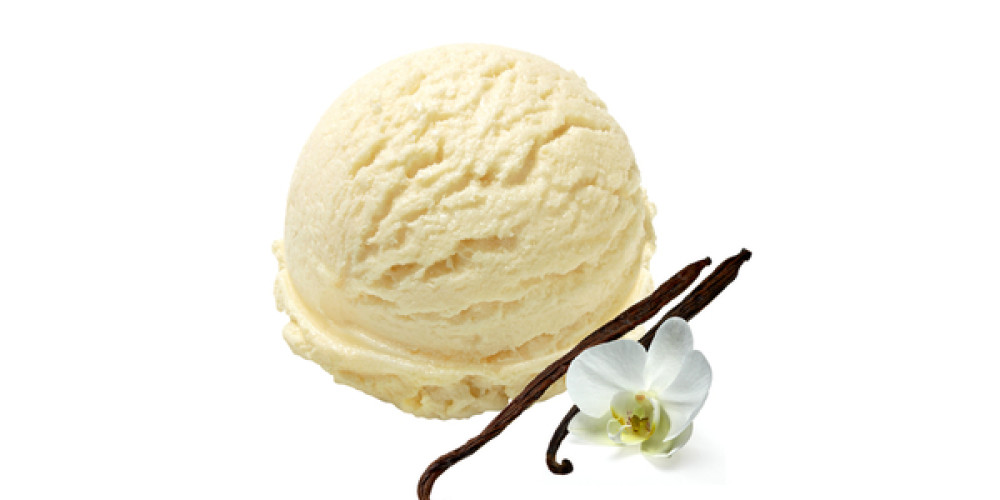
If only vanilla beans, vanilla extract, and/or natural vanilla flavor are used to achieve the vanilla taste, an ice cream may be labeled as "vanilla ice cream" or a vanilla blossom/pod may be depicted on it.
Vanilla is a popular and expensive ingredient. For this reason, flavors with a vanilla taste are often used. These flavors are not obtained from vanilla beans but are chemically-synthetically or biotechnologically produced. These products may not be called vanilla ice cream. The use of artificially produced vanilla flavors must be identified by the indication "with vanilla flavor", e.g. "milk ice with vanilla flavor".
For consumers, it is very difficult to determine the taste differences between real or artificially produced vanilla. If the labeling is insufficient or incorrect, the consumer is deceived. This is a common reason for complaints by the food monitoring authorities.
Since 2016, CVUA Sigmaringen has been examining vanilla flavors in ice cream. In 2016, the designation "vanilla ice cream" was used in 4 out of 12 samples, although vanillin (not derived from vanilla) was used. Also, in 2017, 12 out of 22 samples were labeled as vanilla ice cream, although no natural vanilla flavors were detectable (CVUA Sigmaringen 2018*).
Therefore, be sure to pay attention to the correct labeling of your products. Official complaints should be avoided by ensuring compliance with all hygiene and legal requirements. Especially in recent months, the publication of complaints according to § 40 Abs. 1a LFGB by food monitoring has already created difficult situations for companies.
We therefore recommend that you pay attention to the following points:
- Basic hygiene and other preventive measures
- HACCP concept including documentation
- Training of personnel regarding hygiene, if applicable, HACCP, and follow-up instruction according to §43 Abs. 4 Infection Protection Act (IfSG)
- Representative sampling plan (microbiological self-monitoring)
- Labeling requirements
- Requirements of the Uniteis hygiene guidelines (see www.uniteis.com)
We are happy to assist you not only with microbiological hygiene self-monitoring but also with these topics related to labeling. Our customer advisors are very happy to help you with any questions.
Source: www.ua-bw.de